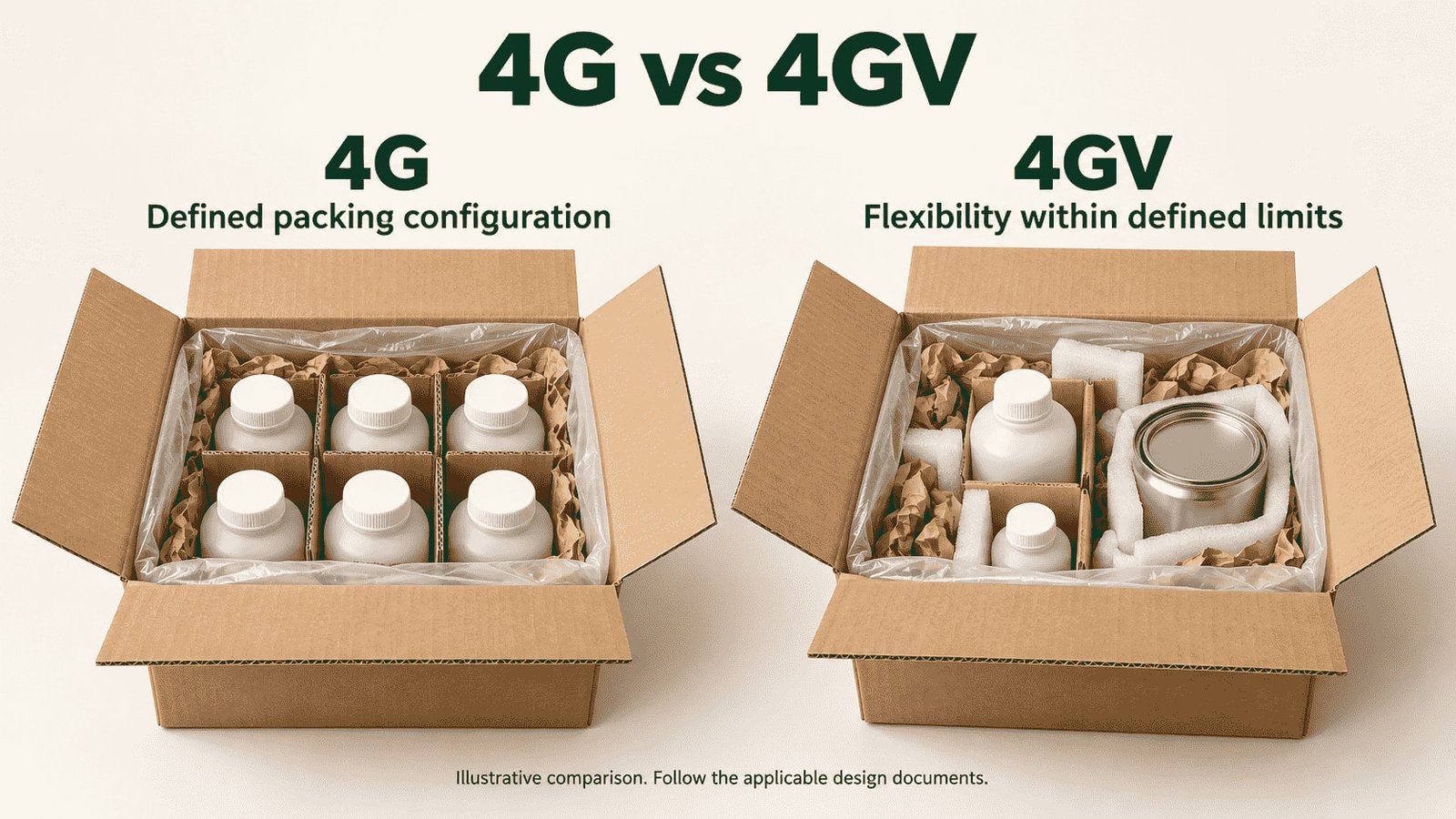
When choosing between 4G and 4GV boxes, start with the inner packagings you intend to use. Consider their materials, dimensions, closures, filled weights and how often the arrangement changes.
A 4G combination package is used according to its tested design and any applicable permitted variations. A 4GV design provides broader scope for different inner packagings, subject to defined conditions. For buyers, the useful comparison is the complete documented packing arrangement. U.S. variation provisions and their conditions are set out in 49 CFR 178.601(g).
The detailed U.S. examples below explain purchasing checks. Your shipment must also satisfy the rules applicable to its contents, route and transport mode.
4G and 4GV at a Glance
In the packaging identification code, 4 means a box and G means fibreboard. The additional V identifies a packaging qualified under particular variation provisions. These letters describe packaging type and qualification; they do not specify the number of corrugated layers. See 49 CFR 178.502 and 178.503(a)(2).
| Buying consideration | 4G combination packaging | 4GV packaging |
|---|---|---|
| Inner-packaging selection | Check the tested arrangement and any permitted variation | Check whether every proposed arrangement meets the variation conditions |
| A useful purchasing starting point | A repeat shipment with a well-defined packing configuration | A programme in which container types or sizes change |
| Main question for the supplier | How does our proposed pack correspond to the documented design? | Which limits apply to our different inner packagings? |
| Information to compare | Containers, layout, components, closures and package weight | The same details, plus the applicable inner-packaging mass and cushioning limits |
| Basis for ordering | A clear specification for the complete pack | A clear specification and documented boundaries for the intended variations |
The purchasing situations in this table are starting points for evaluation. Either choice needs a design-specific review.
What 4G Means for a Repeat Order
For a repeat shipment, establish a reference configuration: the outer box, inner containers, their arrangement, internal protection and closures. This gives purchasing and packing teams a consistent specification to work from.
A change to a bottle or container does not automatically mean that the entire package must be retested. The UN Model Regulations describe conditional changes involving inner-packaging size, design, material, openings, closures, orientation and cushioning. Those conditions need to be checked together. UN Model Regulations, Rev. 24, 4.1.1.5.1.
If a container supplier changes its product, send the revised specification to the packaging supplier before the next order. A useful review includes photographs and closure details as well as dimensions. Two containers with the same capacity can have different shapes and packing needs.
How 4GV Flexibility Works
A 4GV design can be worth evaluating when your shipping programme uses several inner-container formats. The supplier should be able to explain the conditions that each proposed arrangement must meet.
For example, ADR’s variation provisions require qualifying tests with fragile liquid-filled inner packagings at the Packing Group I drop height, as well as an empty-outer-packaging stacking test. These qualification conditions make the design documents important when evaluating a 4GV option. ADR 2025, 6.1.5.1.7(a) and (d).
Weight and available space are only part of that review. Cushioning between containers and around the outside, absorbent materials and any required containment also matter. In a U.S. interpretation concerning 4GV packaging, PHMSA found that certain proposed arrangements did not comply because the required cushioning was not maintained, even though weight conditions were addressed. PHMSA Interpretation 13-0010.
For purchasing, ask for a documented arrangement for each container format you plan to use. That makes the scope of the proposed flexibility visible before you compare prices or place an order.
Check Two Different Weight Limits
Ask the supplier to distinguish:
- Maximum gross package mass: the complete packed package, including its contents and packaging materials.
- Permitted combined gross mass of the filled inner packagings: the inner containers, their closures and their contents together.
These figures serve different purposes. Under U.S. Variation 2, the combined gross mass of the filled inner packagings may not exceed half the corresponding mass used in the drop test. That calculation does not mean halving the maximum gross mass printed on the box. 49 CFR 178.601(g)(2)(ii).
Request the applicable limits for your proposed pack in writing. Include the weight of each empty inner container and its filled weight in your enquiry so the supplier can review the actual arrangement.
Choose Around Your Packing Routine
A consistent container used for repeat shipments
If your business repeatedly ships the same container in the same quantity, begin by evaluating a documented 4G configuration. Compare the components, packing sequence and complete-package specification with your operation. Ask how future container or material changes will be reviewed.
Several container formats within one shipping programme
If your container range changes frequently, ask whether a suitable 4GV design could accommodate the intended formats. Compare each arrangement, including the space available for protection and the resulting package dimensions. Flexibility is most useful when the packing team has clear instructions for the configurations it will actually use.
These are purchasing scenarios, not confirmation that a particular box is suitable for a particular dangerous good.
Ask for the Documents Behind the Quotation
The UK Vehicle Certification Agency explains that the packaging mark alone does not disclose the inner-packaging arrangement, cushioning requirements or closure method. The relevant documents and instructions supply that detail. VCA guidance on using UN packaging.
Ask the supplier to connect the following information to the exact design being quoted:
| Information to request | Purchasing question it helps answer |
|---|---|
| Design identification, complete marking and relevant test or approval documents | Which design is being offered? |
| Inner-packaging specifications and arrangement | How does our proposed pack fit within its documented scope? |
| Box dimensions and component list | What space and components does the arrangement require? |
| Assembly and closure instructions | What will our packing team need to do? |
| Applicable weight limits | Which weights must be checked before dispatch? |
| Quotation inclusions and exclusions | Are inserts, liners, absorbents and closure materials included or separate? |
Compare the complete supply scope alongside unit price. An outer-box-only quotation and a quotation including internal components require different purchasing and assembly plans.
Three Marking Questions Worth Clarifying
Does an X mark mean the box is 4GV?
X identifies the performance test level associated with Packing Groups I, II and III. V identifies the particular variation qualification. A 4G package can also carry an X performance mark, so read both parts of the marking. 49 CFR 178.503(a)(2)–(3).
Does S mean the package can contain only solids?
S is used for packagings intended for solids or inner packagings. It can therefore appear on a combination package containing liquid-filled inner containers. The permitted contents still need to match the applicable requirements and documented arrangement. 49 CFR 178.503(a)(5).
Can I choose a different sealing tape?
Check the specified closure instructions before substituting tape or changing the sealing pattern. U.S. requirements call for closure information that enables the package to be assembled and closed consistently with the tested method. 49 CFR 178.2(c).
Discuss Your Proposed Pack with Chenjie Pack
For a custom UN box enquiry, share the product classification, inner-container specifications, quantities, filled weights and intended transport mode. Chenjie Pack can review the box structure, internal protection and documentation needed for the proposed project.